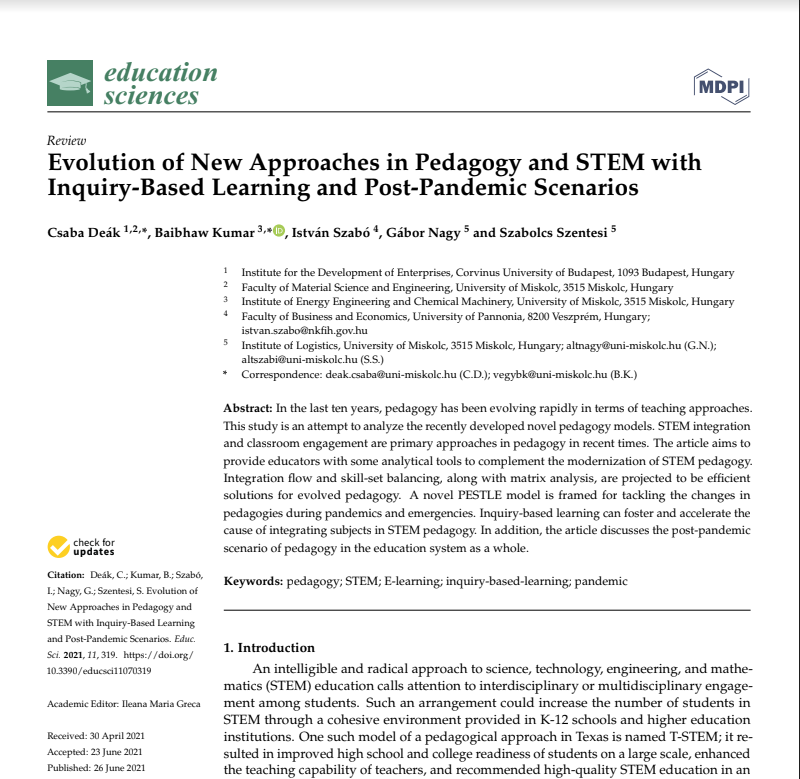
Evolution of New Approaches in Pedagogy and STEM with Inquiry-Based Learning and Post-Pandemic Scenarios
By Csaba Deák, Baibhaw Kumar, István Szabó ,Gábor Nagy & Szabolcs Szentesi
Abstract
In the last ten years, pedagogy has been evolving rapidly in terms of teaching approaches. This study is an attempt to analyze the recently developed novel pedagogy models. STEM integration and classroom engagement are primary approaches in pedagogy in recent times. The article aims to provide educators with some analytical tools to complement the modernization of STEM pedagogy. Integration flow and skill-set balancing, along with matrix analysis, are projected to be efficient solutions for evolved pedagogy. A novel PESTLE model is framed for tackling the changes in pedagogies during pandemics and emergencies. Inquiry-based learning can foster and accelerate the cause of integrating subjects in STEM pedagogy. In addition, the article discusses the post-pandemic scenario of pedagogy in the education system as a whole.
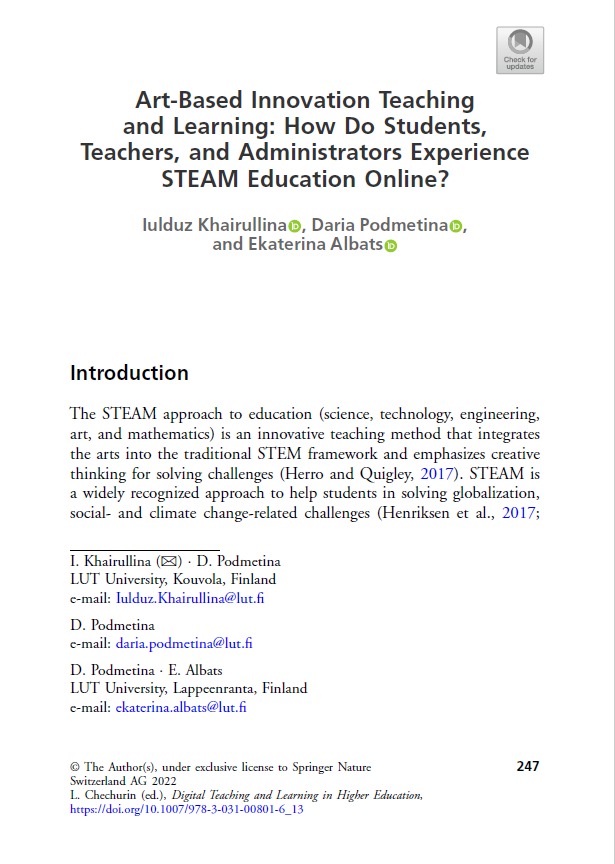
Art-Based Innovation Teaching and Learning: How Do Students, Teachers, and Administrators Experience STEAM Education Online?
By Khairullina Iulduz, Podmetina Daria & Albats Ekaterina
Abstract
STEAM education, incorporating the arts into traditional STEM (science, technology, engineering, and maths) studies, is spreading globally. The arts component is called out to promote creative and innovative thinking among STEM learners. As with any novel educational trend, STEAM (science, technology, engineering, the arts, and mathematics) teaching and learning methods have been predominantly developing in the offline settings, especially given the creative nature, softness, and tacitness of learning goals brought in by the arts. However, this global digitalization trend which has been further enforced by the Covid-19 pandemic has pushed the entire educational field to online spaces and STEAM studies had to follow. Given the relative novelty of STEAM, as well as the new normal of online settings that it has to adapt to, our knowledge and understanding of how STEAM studies will survive the shift to the digital era remain very limited. In this study, we analyze the case of a STEAM-based study program on innovation, which was conceptualized as an offline program before the pandemic and had to transform into a fully online format following the global lockdown. Applying the Community of Inquiry (COI) pedagogical framework we analyze in depth the perspectives of all the course participants—students, teachers, and administrative staff—their experiences, their adaptation to the shift into an online space and the lessons learned. Our study shares theoretical, practical, and policymaking implications on STEAM teaching and learning.
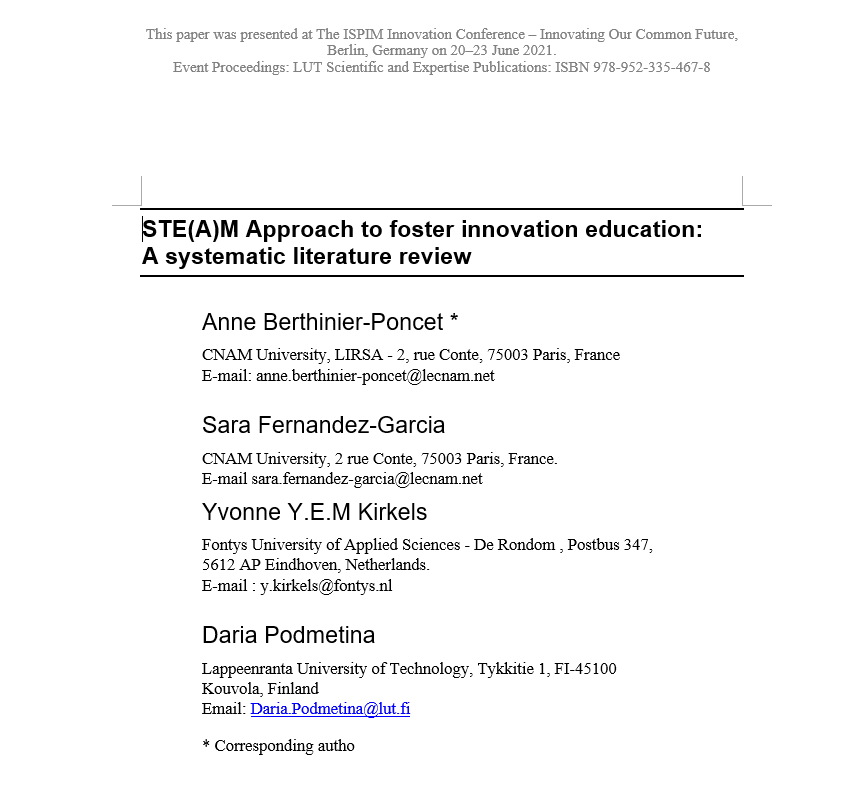
ISPIM Innovation Conference 2021, Berlin
Paper presented titled "STE(A)M Approach to foster innovation education: A systematic literature review
By
Anne Berthinier-Poncet
Sara Fernandex-Garcia
Yvonne Kirkels
Daria Podmetina
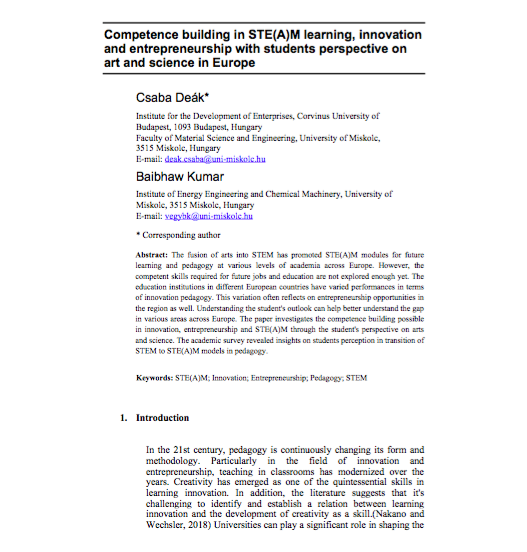
ISPIM Innovation Conference 2022
Paper presented titled "Competence building in STE(A) learning, innovation and entreprenusrhip with student perspective on art and science in Europe
by Csaba Deák and Baibhaw Kumar
ISPIM Innovation Conference 2022
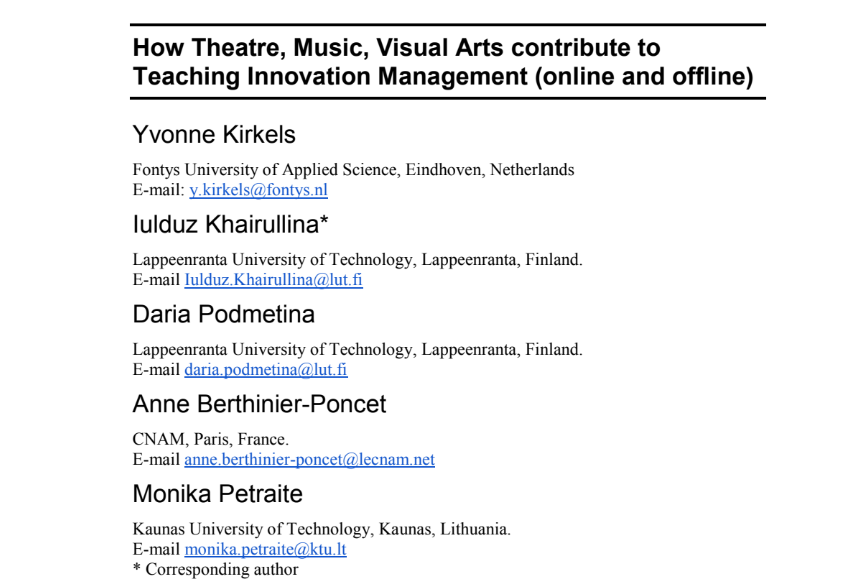
Paper presented titled "How Theatre, Music, Visual Arts contrivute to Teaching Innovation Management (Online and offline)
By
Yvonne Kirkels
Iulduz Khairullina
DAria Podmetina
Anne Berthinier-Poncet
Monika Petraite